Posts

Dr. Edward Sylvester Morse: Marine Biologist, Collector, and Scholar

Image
Dr. Edward Sylvester Morse Marine Biologist, Collector, and Scholar Yoshu Chikanobu (1838 - 1912, Japanese),  Tokyo Aristocratic School Picture of Banquet of Gakushu , 1877, Woodblock print, 36 x 72 cm, ChY.04.09 a-c  Many may not know, but here at the Whyte Museum, we have a rich and diverse collection of Japanese objects and art. In January 2018, Dr. Gain Chin, an Associate Professor Emeritus at the University of Regina, provided a scholarly assessment of our Japanese collection. She was able to add depth and clarity about the cultural significance and value of our collection. How you may ask, did we acquire such objects? Come with us on a journey of the man known as Dr. Edward Sylvester Morse.  Morse specialized in the study of malacology, which focuses on mollusca. Mollusca includes snails, slugs, clams, octopus, squid, and so on. As a marine biologist he focused heavily on this classification of invertebrates. In 1870, he published a book th...

Artifact Feature: Pony Premno No.6 Camera

Image
Artifact Feature Pony Premno No.6 Camera Camera, 1810-1910, Wood; Skin; Metal; Glass, 104.41.0007 This small, bellows camera is a Pony Premno No.6. The Premno camera line was produced by the Rochester Optical Company. As technology changed and photography became more popular, the wants of the average consumer also changed. No longer did the heavy and cumbersome cameras of the past have a place in the everyday life of an amateur photographer. They wanted a lighter, less bulky camera that was easily transported.  This particular camera has a 9 x 12 cm quarter plate, f/ 4.5 150 mm Planatograph lens, and a Bausch & Lomb pneumatic shutter [2]. It also has a tilting and reversing back, which allows for either portrait or landscape pictures to be taken. The ground glass screen is a ". . . sheet of glass with matted surface, placed in the plane to be occupied by the sensitized plate. When the image on screen is sharp the camera [is] correctly focused [1...

The Beach House Hotel: Lake Minnewanka's First Hotel

Image
The Beach House Hotel Lake Minnewanka's First Hotel  [Beach House, Lake Minnewanka], ca. 1890, A. B. Thom (Winnipeg, MB),  Whyte Museum of the Canadian Rockies, Brett Family fonds (V83/PA/7/231) Arriving in Banff in 1886, Willoughby John Astley, along with W. H. Desbrowne, decided to build the first ever hotel on Lake Minnewanka. A log structure was completed in 1886/87 and aptly named the Beach House Hotel.   [Lake Minnewanka], [1890],  Whyte Museum of the Canadian Rockies,  Astley Family fonds (V394/PA-1) In June of 1889, Willoughby's brother, Charles D'oyley Astley, his wife Lucy Ann Andrew, and their infant daughter Violet Louisa would join him at the hotel.  In 1890 Willoughby was contracted by the Canadian Pacific Railway to build a small two bedroom chalet at Laggan, now known as Lake Louise (pictured below). After the construction , Willoughby was hired to run this chalet at Laggan and a fter his departure, his br...

A Look Back: A Year of Celebrations

Image
[ Untitled], ca. 1929 to 1964, Peter and Catharine Whyte fonds (V683/III/A/15/PA-184) As we begin 2019 we reflect back on our 50th anniversary celebrations and another great year here at the Whyte. For our anniversary, the Museum hosted exhibitions and events to mark the occasion. Let's take a look at this years past events!  Odo Kokusei, Snow in the Dawn, Tale of Prince Genji, 1878, woodblock print, KkO.04.01 a-c From Morse to Whyte: A Dynastic Bequest of Japanese Treasures April 14 to June 10, 2018 Catharine Robb Whyte's maternal grandfather, Dr. Edward Sylvester Morse (1838-1925) was a scholar with a vast range of interests, including Japanese culture. This exhibition included ceramics and other artistic and cultural objects.  Artistry Revealed: Peter Whyte, Catharine Robb Whyte and Their Contemporaries June 17 to October 21, 2018 In 2018, with the help of our community the Whyte Museum celebrated its 50th anniversa...

The Path to Plein Air Painting: A Peek at Pigments

Image
The Path to Plein Air Painting Part I: A Peek at Pigments   Box, 1880-1939, Metal; Wood, 104.39.1003 Pigment:   A substance used for colouring or painting, especially a dry powder, which when mixed with oil, water, or another medium constitutes a paint or ink. At the Whyte we have approximately 16,000 paintings and drawings. A large percentage of these are attributed to our founders Peter Whyte and Catharine Robb Whyte. In order to understand how it was possible for Peter and Catharine to paint we must explore the materials that allowed them to paint.  Without the development of pigments, mediums, and artistic tools, artists, like Peter and Catharine would not have been able to become the artists they were.  Join us as we explore the history of that development.  The long history of pigments has been a deadly, expensive, and continuous endeavour. In the past, artists have used a variety of pigments that were sourced from animals, insect...

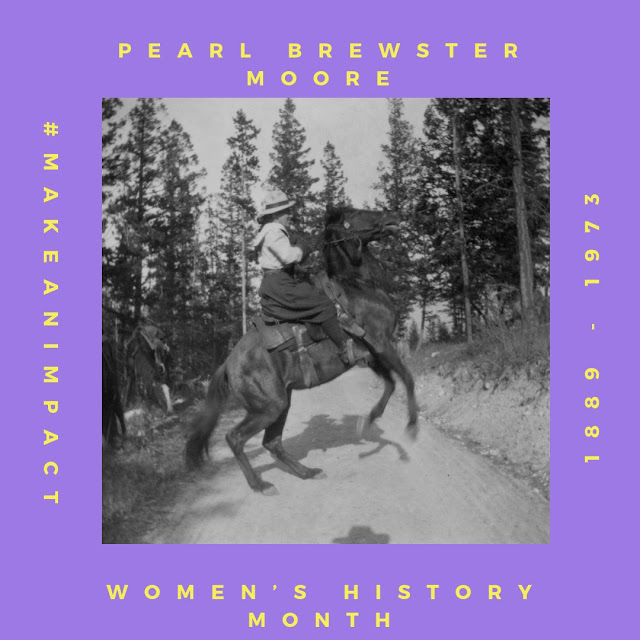
Women's History Month: Pearl Brewster Moore

Image
Pearl Brewster Moore was born in July of 1889. She was the fifth child of the Brewster family and the only girl out of seven siblings. An avid horse rider, collector, hunter, sports enthusiast, and community leader, Pearl was heavily involved with many Banff community events such as the Banff Winter Carnival and the Second World War Banff-Jasper Spitfire fund. As a member of the Calgary hockey team, Calgary Regents, she won Champions of Western Canada in 1917, 1919, and 1920. She was committed to organized sports and would continue to play the game late into her life. Her passion for horses was directly translated into her having the position of Vice President of the Trail Riders of the Canadian Rockies from 1925 to 1933. In 1933, she would become the first woman President of the organization. As an accomplished rider, she taught her horse, Guerney to walk on its hind legs. Pearl also had a personal relationship with the Stoney Nakoda which stemmed from her childho...