Posts

The Path to Plein Air Painting: A Peek at Pigments

Image
The Path to Plein Air Painting Part I: A Peek at Pigments   Box, 1880-1939, Metal; Wood, 104.39.1003 Pigment:   A substance used for colouring or painting, especially a dry powder, which when mixed with oil, water, or another medium constitutes a paint or ink. At the Whyte we have approximately 16,000 paintings and drawings. A large percentage of these are attributed to our founders Peter Whyte and Catharine Robb Whyte. In order to understand how it was possible for Peter and Catharine to paint we must explore the materials that allowed them to paint.  Without the development of pigments, mediums, and artistic tools, artists, like Peter and Catharine would not have been able to become the artists they were.  Join us as we explore the history of that development.  The long history of pigments has been a deadly, expensive, and continuous endeavour. In the past, artists have used a variety of pigments that were sourced from animals, insect...
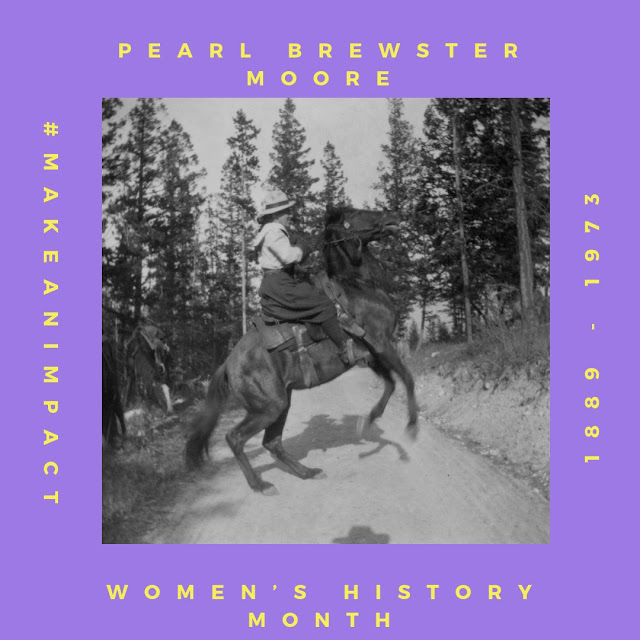
Women's History Month: Pearl Brewster Moore

Image
Pearl Brewster Moore was born in July of 1889. She was the fifth child of the Brewster family and the only girl out of seven siblings. An avid horse rider, collector, hunter, sports enthusiast, and community leader, Pearl was heavily involved with many Banff community events such as the Banff Winter Carnival and the Second World War Banff-Jasper Spitfire fund. As a member of the Calgary hockey team, Calgary Regents, she won Champions of Western Canada in 1917, 1919, and 1920. She was committed to organized sports and would continue to play the game late into her life. Her passion for horses was directly translated into her having the position of Vice President of the Trail Riders of the Canadian Rockies from 1925 to 1933. In 1933, she would become the first woman President of the organization. As an accomplished rider, she taught her horse, Guerney to walk on its hind legs. Pearl also had a personal relationship with the Stoney Nakoda which stemmed from her childho...

Women's History Month: Catharine Robb Whyte

Image
Known for her generosity and love of people, Catharine continues to play a vital role in the vision of the Whyte Museum. Artist, philanthropist, community leader, and friend, she was a significant figure in the Bow Valley. Born in Concord, Massachusetts, Catharine selected the School of the Museum of Fine Arts in Boston to study art. There, in 1925, she would meet Peter Whyte. They would marry in June of 1930. An avid letter and diary writer, Catharine’s descriptions of the places she visited and the people she met are a testament to the vast appreciation she had for the Canadian Rocky Mountains. With over 400 paintings, Catharine was an accomplished landscape and portrait artist. Catharine’s paintings illustrated and reflected her own emotions. As her nephew, Jon Whyte once remarked, “People may read her landscapes as simple depiction but this always dynamic, congenial, considerate, charitable and democratic woman, her face illuminated by a smile and her love of life, create...

Women's History Month: Elizabeth von Rummel

Image
October is Women’s History Month (Canada). Throughout the month of October we will be featuring and celebrating women. From mountaineers, to guides and artisans, let’s celebrate the diversity of women in the Canadian Rockies!  Born to an aristocratic family in Germany, Elizabeth, later known as Lizzie came to Canada with her family for the first time in April of 1911. Eventually, the family moved permanently to Canada. Lizzie’s first experience in the back country of Assiniboine was in 1938, where she was a chambermaid, hostess, and guide. She participated in many activities such as climbing, hiking, and skiing. In 1943, she began the management of the Skoki Lodge. By 1947, she was managing the Temple Chalet, Lake Louise Ski Resort, and Skoki Lodge. In December 1950, at the age of 54, Lizzie was finally able to purchase her cabin at Sunburst Lake, near Assiniboine. She spent twenty years running the Sunburst Lake Camp. On December 20th 1979, she was awarded the Order of Can...

The Banff Paradox: Everyone's Serene Getaway from Everyone Else

Image
The Banff Paradox:            Everyone's Serene Getaway from Everyone Else Guest Writer Gemma Tarling, Summer Interpreter 2018  A mere 9,658 people call Banff home, yet the popular tourist destination receives millions of visitors every year (Enns 2018). Since 1885, when the Canadian Government established the area as the Hot Springs Reserve, the township has been orchestrated with tourism in mind. Diverse marketing campaigns draw people from all backgrounds to this idyllic destination: for skiing, hiking, pristine views of the Canadian Rockies, or maybe to stay at the monumental Fairmont Banff Springs hotel. From the start, Banff has been sustained by its visitors, but how have modern advancements in technology changed the way that those visitors come to and interact with the parks? Reflecting on my summer here drew to my attention the juxtaposition of the history of Banff I relate on tours and the current state of the town. The...

Mary's Animals: A Selection of Fauna from the Canadian Rocky Mountains

Image
Mary's Animals A Selection of Fauna from the Canadian Rocky Mountains Part II  Mary Schäffer Warren captured more than just the landscapes and botanical specimens of the Canadian Rockies in her images. She was also able to capture the life that lived and thrived in these mountains. The sheer diversity shown by Mary's photographs and lantern slides illustrates the ecological diversity of the Rocky Mountains.  As previously stated in Part One, Mary's Flowers: A Selection  of Flora from the Canadian Rocky Mountains , her attention to the detail of colour was accomplished through the laborious job of hand-colouring each picture and slide.   We can imagine what it was like to be in her shoes, traversing through the Rocky Mountains and stumbling across a wide range of wildlife. Born and raised as an upper-class woman in Pennsylvania, she had a lot to experience and learn. Want to find out more about Mary Schäffer Warren? You can pick up h...

The Work of Giants: Glaciology and Glacial Retreat in the Canadian Rockies

Image
The Work of Giants Glaciology and Glacial Retreat in the Canadian Rockies Guest Writer Eden Luymes,  Summer Interpreter 2018  The Illecillewaet Glacier in 1898, with the glacier’s extent in 1887 marked on a rock. For centuries, glaciers have been hard at work. Like giant sculptors, ancient glaciers carved out entire valleys and chiseled towering mountains. They continue to supply lakes, rivers, and even distant oceans with water. They are ever changing; always moving and flowing. The only constant for these impressive giants is change. However, that change is becoming increasingly rapid, and increasingly permanent: our glaciers are retreating.  The first people to study glaciers in the Canadian Rockies were the Vaux family. A Quaker family from Philadelphia, they first visited these mountains in the summer of 1887, and would make many return trips to the region. Mary, George, and William Vaux, all siblings, took an interest in these glaciers whe...