Posts

Showing posts with the label From Our Collections

Gems Within: Animals
Image
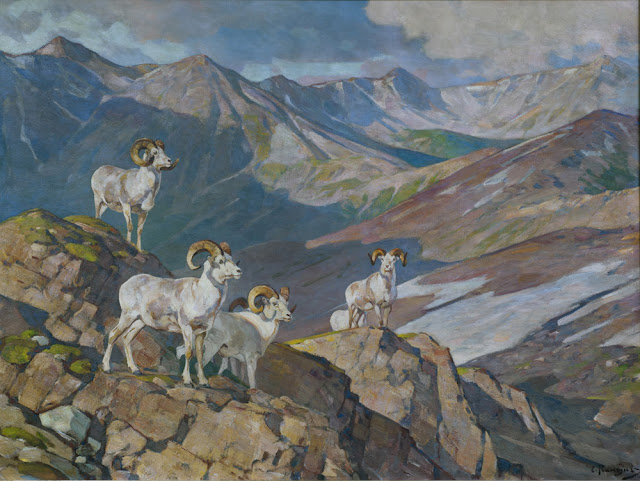
Gems Within: Animals The title of this blog post, Gems Within , is the primary theme of our Founders' Gallery here at the Whyte Museum. The purpose of this gallery is to showcase treasured objects from the Museum collection. In this post, we have selected a handful of those objects and art centred around a theme, animals.   Do you have a favourite animal? Share yours below in the comments! Stay tuned for more Gems Within  feature posts! Carl Clemens Moritz Rungius (1869-1959, American) In the Ogilvie Rockies, 1940 C, oil on canvas, 74.5 x 100.5 cm, RuC.02.15  J. Monroe Thorington (1894-1989, American) Rocky Mountain Goat, 1970 P, charcoal on paper, 38.0 x 23.0 cm, ThM.03.05 Skull, bear, 1928-1932,  bone, 112.01.0030 Boylston Dummer Mountain Lion, Banff,  n.d., woodcut on paper, 22 x 22 cm, DuB.04.01 Tsukioka Kōgyo (1869-1927, Japanese) Untitled, n.d., woodbl...

Dr. Edward Sylvester Morse: Marine Biologist, Collector, and Scholar

Image
Dr. Edward Sylvester Morse Marine Biologist, Collector, and Scholar Yoshu Chikanobu (1838 - 1912, Japanese),  Tokyo Aristocratic School Picture of Banquet of Gakushu , 1877, Woodblock print, 36 x 72 cm, ChY.04.09 a-c  Many may not know, but here at the Whyte Museum, we have a rich and diverse collection of Japanese objects and art. In January 2018, Dr. Gain Chin, an Associate Professor Emeritus at the University of Regina, provided a scholarly assessment of our Japanese collection. She was able to add depth and clarity about the cultural significance and value of our collection. How you may ask, did we acquire such objects? Come with us on a journey of the man known as Dr. Edward Sylvester Morse.  Morse specialized in the study of malacology, which focuses on mollusca. Mollusca includes snails, slugs, clams, octopus, squid, and so on. As a marine biologist he focused heavily on this classification of invertebrates. In 1870, he published a book th...

Artifact Feature: Pony Premno No.6 Camera

Image
Artifact Feature Pony Premno No.6 Camera Camera, 1810-1910, Wood; Skin; Metal; Glass, 104.41.0007 This small, bellows camera is a Pony Premno No.6. The Premno camera line was produced by the Rochester Optical Company. As technology changed and photography became more popular, the wants of the average consumer also changed. No longer did the heavy and cumbersome cameras of the past have a place in the everyday life of an amateur photographer. They wanted a lighter, less bulky camera that was easily transported.  This particular camera has a 9 x 12 cm quarter plate, f/ 4.5 150 mm Planatograph lens, and a Bausch & Lomb pneumatic shutter [2]. It also has a tilting and reversing back, which allows for either portrait or landscape pictures to be taken. The ground glass screen is a ". . . sheet of glass with matted surface, placed in the plane to be occupied by the sensitized plate. When the image on screen is sharp the camera [is] correctly focused [1...

Banff Sanitarium Hotel: Mineral Springs, Monkeys, and Medicine

Image
Brett Sanitarium Hotel Mineral Springs, Monkeys, and Medicine Bretton Hall Banff, [b/t 1923 & 1933], George Noble fonds (V469/1835) In 1851, a baby boy was born to James Brett and Catherine Mallon in Strathroy, Upper Canada. This boy would become known as Robert George Brett, or more commonly Dr. Brett. He would graduate from Victoria College Medical School, as a Medical Doctor in 1874.  Dr. R.G. Brett and Nurse McCall, ca. 1912, George Paris fonds (V484/969/NA66/1998) After further education, work, and travel, Dr. Brett joined the Canadian Pacific Railway on its endevour to build the transcontinental railway in 1881. During this time he concocted the vision to open a hotel and sanitarium based on the use of the mineral springs found in Banff.  C.P.R. Engine 73 and train, [1880- 1890], Boorne and May Fonds (V10/1/90/NA66-690) 608. C.P.R. at Banff, [1887 or 1888], Boorne and May fonds (V10/PD/1/009) The site was selected and com...

Discovering History Through Art

Image
The Portraits of Nicholas de Grandmaison Igor and Andrei admiring Nicholas de Grandmaison's painting of his wife Sonia.  Three weeks ago author Igor Krasnov stopped at the Whyte Museum while on vacation to view the artworks of the man he'd been researching and writing about for the last decade: Nicholas de Grandmaison. What began as an interest in learning about his new home in Victoria, B.C. after emmigrating from Russia, evolved into a journey to discover the story of fellow Russian immigrant and renowned artist Nicholas de Grandmaison.  His quest began at his local library where he discovered the famous Canadian painter Emily Carr. Known for her modernist depictions of the Pacific Northwest Coast lifestyle, Carr's lack of Indigenous Peoples portrayed in her paintings surprised Krasnov. Upon further research Krasnov discovered a story in one of her books explaining why she didn't paint portraits of Indigenous Peoples. According to Carr, she once tried...

The Yodeling Cowboy

Image
Name: Wilf Carter (Wilfred Alfred Charles Carter) Nicknames: Father of Canadian Country Music, Montana Slim Birth: December 18th, 1904 - Port Hilford, Nova Scotia Death: December 5th, 1996 - Scottsdale, Arizona Occupation: Yodeling Cowboy  Some people might find it odd that a boy from Port Hilford, Nova Scotia wanted to be a cowboy, but for those who have been lucky enough to go after a dream and see it realized in the West, it doesn't seem so crazy.  First inspired by a touring Swiss vaudeville artist known as 'The Yodeling Fool' when he was ten years old, Wilf made the decision to move to Alberta in the early 1920's. He began his career performing at dances, camps, bunkhouses, and house parties, eventually joining the Canadian rodeo circuit where he also competed. By 1929 he had moved to Calgary and was singing on a Calgary radio station, CFCN, as well as CFAC, and nationally on CRBC.  By this point Wilf had also taught himself how to play guitar. In re...